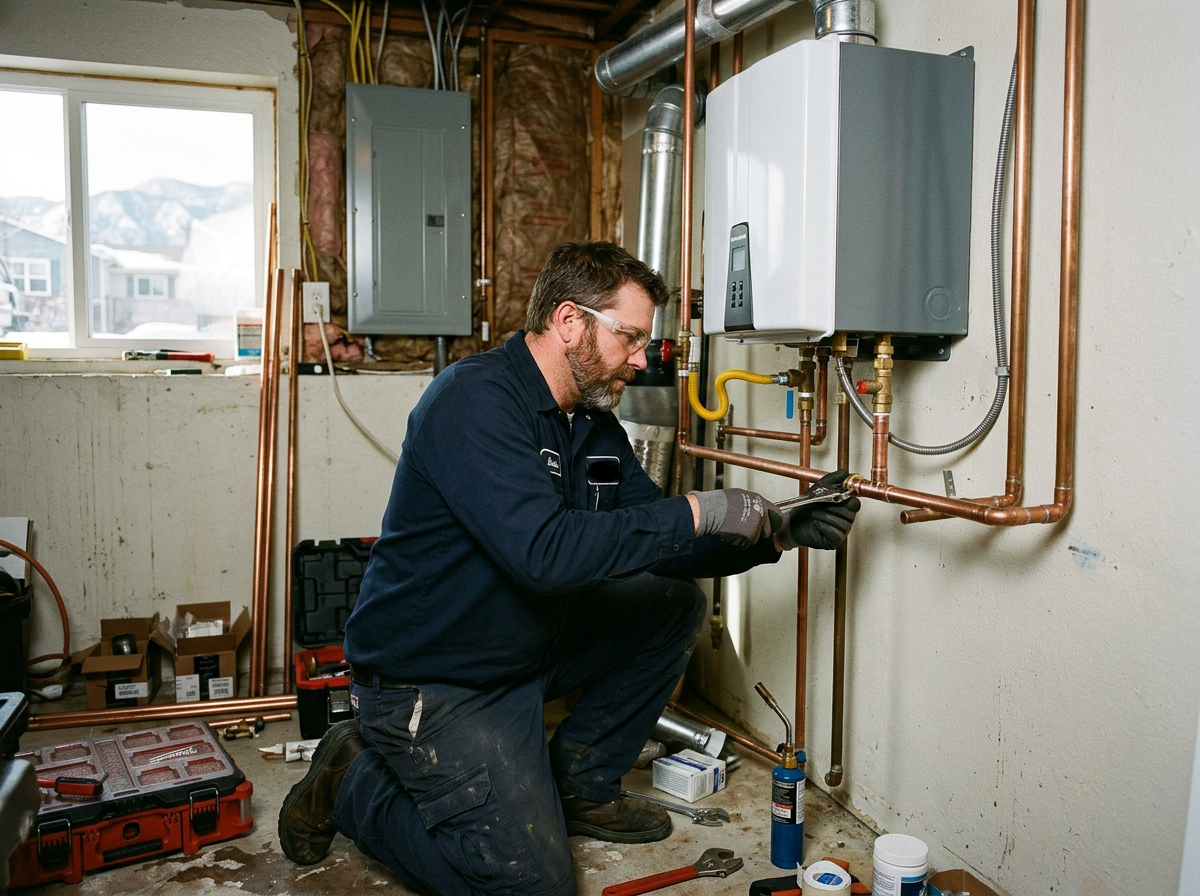
Proper tankless sizing starts with first-hour rating calculations that factor in Denver's 5280 ft elevation, where thinner air reduces combustion efficiency and peak flow. We measure simultaneous fixture demand across showers, sinks, and appliances, then adjust for incoming groundwater temperature that runs colder here than coastal areas. Oversized units waste energy while undersized ones deliver lukewarm water during peak morning use in households with multiple bathrooms.
Venting and combustion air requirements changed with the 2026 ultra-low NOx mandate. Atmospheric units that once vented into existing chimneys are no longer sold or installed; sealed-combustion models with power venting need dedicated intake and exhaust runs plus a dedicated electrical circuit. Pre-war bungalows in Capitol Hill and Baker often require creative routing through exterior walls, while newer homes in Parker or Thornton allow straightforward horizontal terminations that maintain proper draft.
Gas line upgrades and expansion tank placement address closed-system conditions created by backflow preventers common in Denver. Hard Front Range water accelerates scale buildup inside heat exchangers, so we include isolation valves for future flushing. Electrical requirements include GFCI protection and proper amperage for the blower and controls, while permits and inspections verify compliance with the new venting standards without mandating replacement of still-functional older units.
Common failures include heat exchanger scaling from untreated hard water and fan motor issues when venting is undersized for elevation. Units installed five to seven years ago with basic maintenance are usually worth repairing, but those showing repeated error codes or leaking exchangers are not economical to fix once parts and labor exceed half the cost of a new compliant model.
Technician insight
In Denver the thing that catches most people out with Tankless Water Heater Installation is underestimating how the 5280 ft elevation plus the new sealed-combustion venting rules turn a simple swap into a multi-day job, especially in Capitol Hill bungalows where chimney access is gone and every exterior wall penetration needs careful planning.
Capitol Hill Bungalow Retrofit
Homeowner wanted tankless but the 1928 utility closet had no room for power-vent routing. We found the existing chimney could not be reused under the new rules. We ran intake and exhaust through an exterior wall, added the required electrical circuit, and installed an expansion tank to address the closed system from the backflow preventer. The unit now delivers consistent hot water without draft issues at altitude.
Tankless Water Heater Installation Services We Offer
✓Tankless Unit Sizing Consultation
We calculate first-hour demand and elevation-adjusted flow rates to select a model that delivers steady hot water without short cycling.
✓Power Vent Installation
Sealed-combustion venting runs and electrical circuits are added to meet the ultra-low NOx requirements that took effect in 2026.
✓Gas Line and Electrical Upgrade
Existing lines are evaluated and upsized where needed to support higher BTU demands of tankless units at Denver altitude.
✓Expansion Tank and Pressure Regulation
Closed-system conditions from local backflow devices are addressed with properly sized expansion tanks to protect the new unit.
✓Hard Water Scale Prevention
Isolation valves and recommended flushing schedules counteract sediment buildup that shortens tankless heat exchanger life in Front Range water.
✓Permit and Inspection Coordination
We handle required permits and schedule inspections to confirm venting and combustion air meet current Denver code.
Tankless Water Heater Installation Cost in Denver, CO
| Service | Typical Range | What Affects It |
|---|---|---|
| Tankless Installation In Newer Construction | $4,800–$7,200 | Straightforward venting and larger gas lines in homes built after 2000 |
| Tankless Installation In Pre-War Bungalow | $6,500–$9,800 | Exterior wall penetrations and tight utility spaces common in Capitol Hill, Baker, and Highlands |
| Gas Line Upgrade | $650–$1,400 | Larger diameter pipe required for higher BTU draw at elevation |
| Power Vent Kit And Electrical Circuit | $1,200–$2,100 | Required for sealed combustion under current NOx rules |
| Expansion Tank And Pressure Work | $350–$650 | Installed when backflow preventer creates closed system |
Ranges are typical for Denver, CO and confirmed with an exact written quote before any work starts.
How it works
- 1
Site Assessment
We inspect existing gas service, venting paths, electrical access, and water pressure in your specific Denver neighborhood.
- 2
Sizing And Equipment Selection
Flow rates and first-hour ratings are calculated with elevation and groundwater temperature adjustments before recommending compliant models.
- 3
Venting And Utility Preparation
Power vent runs, intake air, and any required gas or electrical upgrades are completed to satisfy the 2026 NOx standards.
- 4
Unit Installation And Testing
The tankless unit is mounted, connected, flushed, and tested for proper ignition, temperature stability, and leak-free operation.
- 5
Final Inspection And Handover
We obtain inspection sign-off and provide maintenance guidance tailored to hard water conditions.
Pricing
Tankless installations now cost more than pre-2026 work because ultra-low NOx models require added venting runs, electrical circuits, and labor that typically add $2,500–$4,000.